
Do you know which are the main parts in a CORREA bed-type milling machine?
Understanding the milling machine parts is essential to know how a CNC milling machine works, evaluate its real condition and ensure accurate, safe and efficient machining. In fixed bed CNC milling machines, each component plays a specific role within a structure designed for heavy-duty machining and high precision.
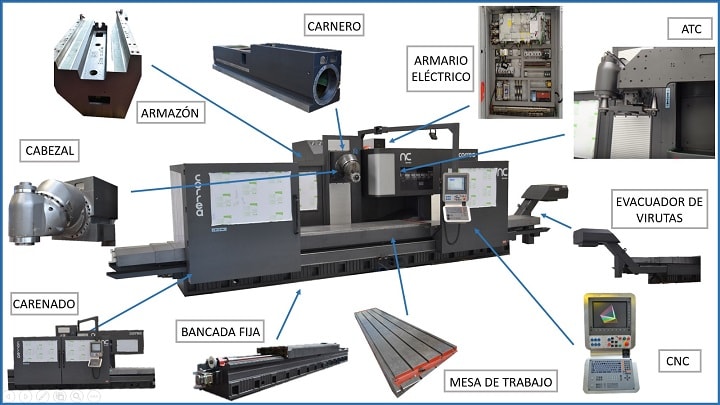
In this article, we explain the main milling machine parts, how they are organised and how they work together, using a CORREA PRISMA 35 milling machine rebuilt by NC Service as a real reference.
What Are the Main Milling Machine Parts?
A CNC milling machine is made up of several mechanical, electrical and control systems that work together to perform complex machining operations automatically.
In general, milling machine parts can be grouped into:
-
Structural and mechanical components
-
Machining and motion systems
-
CNC control system
-
Electrical and electronic components
-
Safety and auxiliary systems
The reliability of the machine depends not only on its original design but also on the condition of each individual component.
Main Parts of a Fixed Bed CNC Milling Machine
Below, we describe the key milling machine parts of a fixed bed CNC milling machine, such as the CORREA PRISMA 35 rebuilt by NC Service, explaining the real function of each element in the machining process.
Bed
The bed is the main structural base of the CNC milling machine and provides direct support to the floor. All other major components are mounted on it.
In fixed bed milling machines, the bed is designed to:
-
Provide high rigidity
-
Absorb vibrations
-
Ensure long-term geometric stability
A solid bed is essential to maintain machining accuracy over time.
Frame
The frame is the rigid structure that supports the ram and allows its vertical movement. It ensures stability and precise guidance of the moving components.
Its rigidity is crucial to prevent deformation and maintain machining accuracy.
Ram
The ram moves transversely along the frame and holds the milling head at its front end. Inside, it contains the entire kinematic transmission system required for machining.
The ram enables precise positioning of the head and is a key element in large CNC milling machines designed for heavy workpieces.
Milling Head
The milling head houses and orients the cutting tool. It uses the power and speed provided by the spindle to perform efficient and accurate machining.
This is one of the most critical milling machine parts, as it directly affects:
-
Surface finish quality
-
Dimensional accuracy
-
Machining stability
Proper alignment and condition of the milling head are essential for optimal results.
Worktable
The worktable is the slotted surface where the workpiece is fixed during machining. It is designed to support heavy loads and allow secure clamping using different fixing systems.
Its flatness and alignment directly influence machining precision.
Automatic Tool Changer
The automatic tool changer (ATC) manages the tools required for machining operations automatically, without manual intervention.
This system provides:
-
Reduced downtime
-
Higher efficiency
-
Automation of complex machining processes
It is an essential component in modern CNC milling machines.
CNC Control
The CNC control manages all electrical and mechanical elements of the milling machine through software and programmed instructions.
It coordinates:
-
Axis movements
-
Milling head operation
-
Tool changes
-
Execution of machining programs
The CNC control is the brain of the machine.
Electrical Cabinet
The electrical cabinet contains and protects all electrical and electronic circuits of the CNC milling machine. Its main function is to minimise risks caused by overloads or electrical failures while ensuring operator safety.
A well-organised electrical cabinet also simplifies maintenance and troubleshooting.
Electrical Equipment and Servo Motors
The electrical equipment includes wiring, sensors, protection devices and servo motors, which control the precise movement of the machine axes.
Servo motors provide:
-
Accurate positioning
-
Smooth motion
-
High repeatability
Chip Conveyor
The chip conveyor removes chips generated during machining and transports them outside the machine.
It plays a key role in:
-
Keeping the working area clean
-
Preventing chip accumulation
-
Protecting mechanical components and guideways
Enclosure
The enclosure consists of doors and protective elements surrounding the machining area. Its purpose is to ensure operator safety by preventing the projection of chips, coolant or debris during machining.
It also helps maintain a cleaner and safer working environment.
How Milling Machine Parts Work Together
All milling machine parts operate in a coordinated way to transform a digital design into a precisely machined component.
The condition of each part directly affects:
-
Surface finish quality
-
Productivity
-
Machine lifespan
-
Operator safety
For this reason, professional maintenance, geometric verification and machine rebuilding are essential to maintain original performance levels.
Understanding milling machine parts allows manufacturers and technicians to properly assess machine condition, detect wear and make informed decisions when purchasing, maintaining or rebuilding a CNC milling machine.
In fixed bed CNC milling machines like the CORREA PRISMA 35 rebuilt by NC Service, every component plays a crucial role in delivering precision, reliability and safety in industrial machining.
Now that you know the main parts of a CNC milling machine, it will be easier for you to understand our article explaining how a CNC milling machine works in detail.