
Types of Industrial Milling Machines and Their Applications in Machining
Industrial milling machines are one of the most widely used machine tools in precision machining. There are different types of milling machines, each designed to work with specific part dimensions, precision requirements or machining conditions.
Understanding the types of industrial milling machines and their applications makes it possible to choose the most suitable machine for each production process, from heavy machining to high-precision work.
In this article we analyze the main types of milling machines used in industry, their characteristics and the situations in which each machine configuration is used.
What is a milling machine and how does it work
A milling machine is a machine tool that uses a rotating cutting tool called a milling cutter to remove material from a workpiece in order to obtain the desired shape.
Machining is performed through the relative movement between the tool and the workpiece, controlled through different machine axes. In modern milling machines, these movements are managed by CNC (Computer Numerical Control), allowing operations with high precision and repeatability.
Milling machines are used for operations such as:
- cavity machining
- contouring parts
- mold manufacturing
- machining structural components
Depending on their structural configuration and machine movement, different types of industrial milling machines can be found.
Main Types of Industrial Milling Machines
Several milling machine configurations are used in industrial machining, each with specific characteristics that determine their working capacity and applications.
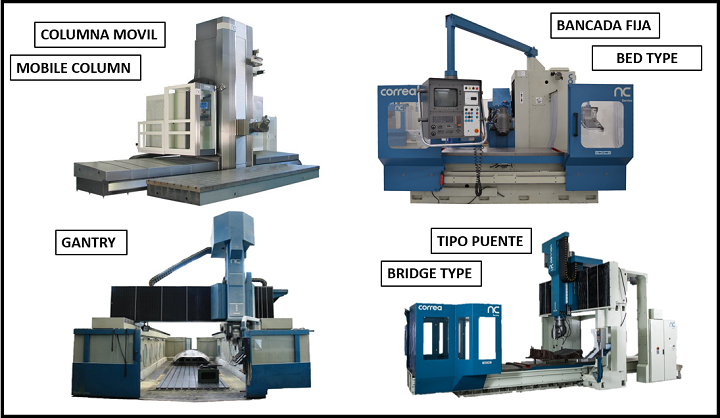
Bed type milling machine
The fixed bed-type milling machine is characterized by a very rigid structure in which the table remains fixed while the head moves along the machine axes.
The working table moves along the bed forming the X axis, while the column houses a spindle that moves the frame vertically along the Z axis. This frame also supports the ram, which moves transversely forming the Y axis.
These machines are designed for machining relatively light workpieces, which is why their X-axis travel usually ranges between 1 and 5 meters.
This configuration allows machining of long parts and is common in the production of industrial components such as:
- metal structures
- heavy machinery components
- large-format parts
This type of milling machine combines good machining capacity with a flexible structure that facilitates working with large components.
The most common use for this type of milling machine is mechanical sector, especially in sectors like die-matricery and die-cutting.
Examples of machines of this type being retrofitted at NC Service could be CORREA "A" range (A10, A16, A25/25, A30/50...), CORREA "CF" range (CF17, CF22/25, CF22/20, CF25/25...), CORREA PRISMA, CORREA DIANA, etc.
Bed type CORREA A30/50 milling machine after its overhauling process could be seen in this video.
Mobile column milling machine
In a mobile column milling machine, the column supporting the head moves along the machine bed while the table remains fixed, keeping the load stable.
The column moves along the side of the table and houses the frame that moves along the Z axis, while also supporting the ram, which moves along the Y axis.
This configuration allows machining of long parts and is commonly used in the manufacturing of industrial components such as:
- metal structures
- heavy machinery components
- large parts
This type of milling machine combines high machining capacity with a flexible structure that facilitates machining large workpieces.
Ideal for heavy pieces as the table where the workpiece is placed remains fixed to the ground which produces less inertia because only the crosshead-framework-ram set is moving.
This type of milling machine is very common in railway and naval industry, and those most usually being refurbished by Nicolás Correa Service are CORREA "L" range (L30/43, L30/84, L30/104...) or ANAYAK "HVM" range (HVM-2300, HVM-3300, HVM-5000, HVM7000).
This retrofitted mobile column CORREA L30/43 is an example of this type of milling machines, while in this video you can see in operation a mobile column Anayak HVM 7000 milling machine.
Fixed bridge and mobile table milling machine
The fixed bridge and mobile table milling machine features a bridge-shaped structure that remains fixed while the table moves longitudinally.
This configuration is widely used when high-precision machining of heavy parts is required.
Its advantages include:
- high structural stability
- good accuracy when machining heavy parts
- excellent performance during long machining operations
The fixed bridge and mobile table milling machine is frequently used in industries where large metal components are machined.
This type has two columns placed at both sides of the bed joined at the top by the crosshead. This crosshead is the support for the framework and both make up Y axis and serve for guiding the ram, which in this case is vertical and forms the displacement of Z axis. X axis is formed by the movement of the table on the bed.
This type of milling machine is ideal for big parts, not too heavy though, and with spherical forms. Very commonly used in energy and aeronautical sectors, but also in general mechanical sector.
NC Service refurbish CORREA "FP" range (FP30/30, FP30/40, FP40/40, FP40/50...) or "EURO 2000" within this type.
This bridge CORREA FP30/40 milling machine is now available for immediate delivery after its mechanical refurbishment. This video shows you a retrofitting process for a similar milling machine.
Gantry milling machine
The gantry milling machine, also known as a moving bridge milling machine, features a structure in which the bridge moves over the table, allowing machining of large parts without compromising precision.
In these machines, the table remains fixed, while the moving bridge and columns—forming the crossbeam-frame-ram assembly—move longitudinally along a pair of rails.
This type of milling machine is common in applications such as:
- machining large components
- manufacturing industrial molds
- machining parts in sectors such as energy or aerospace
Its design allows coverage of large working areas while maintaining high structural rigidity.
Commonly used when customers need to machine large and heavy pieces, as there are no limitations about the weight to be placed on the table.
The most common application is for the mechanical sector, mainly for die-matricery and die-cutting sectors.
The CORREA Pantera milling machine, available for delivery and start-up at a customer´s facilities, is one example of this type of machines.
Milling Machine Comparison Table
|
Type of Milling Machine |
Main Characteristics |
Typical Applications |
|---|---|---|
| Fixed Bed Milling Machine |
High structural rigidity and machining stability |
Heavy machining and large workpieces |
|
Moving Column Milling Machine |
Column moves along the bed |
Long parts and industrial structures |
|
Fixed Bridge Milling Machine |
Fixed bridge with moving table |
Heavy components requiring high precision |
|
Gantry Milling Machine |
Moving bridge over the table |
Large parts and industrial mold manufacturing |
How to Choose the Right Type of Milling Machine
Choosing the right type of milling machine depends on several technical factors related to the workpiece and the machining process.
The most important aspects include:
- size and weight of the workpiece
- type of material to be machined
- required precision
- production volume
- type of machining operations
Selecting the right machine helps improve production efficiency and ensures the quality of the final result.
Frequently Asked Questions About Industrial Milling Machines
What type of milling machine is used for large parts?
To machine large workpieces, fixed bridge milling machines, gantry milling machines, or moving column milling machines are typically used. These configurations offer a robust structure and large working travels, allowing the machining of large industrial components while maintaining precision.
What milling machine is used for heavy machining?
Heavy machining requires milling machines with a particularly rigid structure capable of withstanding high cutting forces. Fixed bed milling machines and fixed bridge milling machines are especially suitable for this type of work because they offer high structural stability and allow machining large workpieces with precision.
What is the difference between a vertical and a horizontal milling machine?
The main difference lies in the orientation of the spindle. In a vertical milling machine, the spindle is oriented vertically, which facilitates operations such as facing or cavity machining. In a horizontal milling machine, the spindle is positioned horizontally and is usually used for heavier machining or for working on the lateral surfaces of large parts.
The different types of industrial milling machines respond to specific machining needs, from high-precision work to the production of large components.
Understanding the characteristics of each configuration allows manufacturers to choose the most suitable machine for each application and optimize production processes.
In addition, through reconstruction and CNC modernization processes, many milling machines can remain highly competitive even in demanding industrial environments.
In case not finding the ideal milling machine solution among our machines in stock, customers can contact our sales team who will assist them in this search or help him finding the best alternative in the market fitting their work.
Attending our costumer’s demands, we have enlarged our availability of machines by incorporating other machine tool for chip removal, highlighting the 5-axis Deckel Maho machining centres.